Why it matters
Staglieno is not a sight in the usual sense; it is an art collection that happens to be a burial ground. Between the eighteen-fifties and the First World War the Genoese middle class commissioned sculpture here on a scale that has no real parallel elsewhere, and most of it is still standing outdoors, free for anyone to walk among at leisure.
The subject matter is as unusual as the quantity. Alongside the expected angels and allegorical figures are ordinary people carved exactly as they lived: a widow in her shawl, a man in a frock coat and spectacles, a street seller with her basket of wares. These are portraits of a class that had money for the first time in its history and wanted to be remembered as itself, not as a classical ideal.
It is also a genuinely large place, covering more than a square kilometer on the slope of the Bisagno valley, with separate English, Protestant, Jewish and Muslim cemeteries contained inside the same perimeter walls.
The reputation is not a modern rediscovery. Nineteenth-century travelers to Genoa came to see Staglieno as they came to see the palaces of the city, and guidebooks of the period listed it among the sights of Italy — a strange fate for a cemetery, and the reason its monuments were made so ambitious in the first place.
How it came to be
The project exists because of a decree of Napoleon in 1804, which banned burial inside churches and town centers across the territories he controlled. Genoa, like every Italian city, had to find ground outside its walls. The cemetery was approved in 1835 and designed by the city architect Carlo Barabino, who died of cholera the same year; his pupil Giovanni Battista Resasco carried the design through to completion.
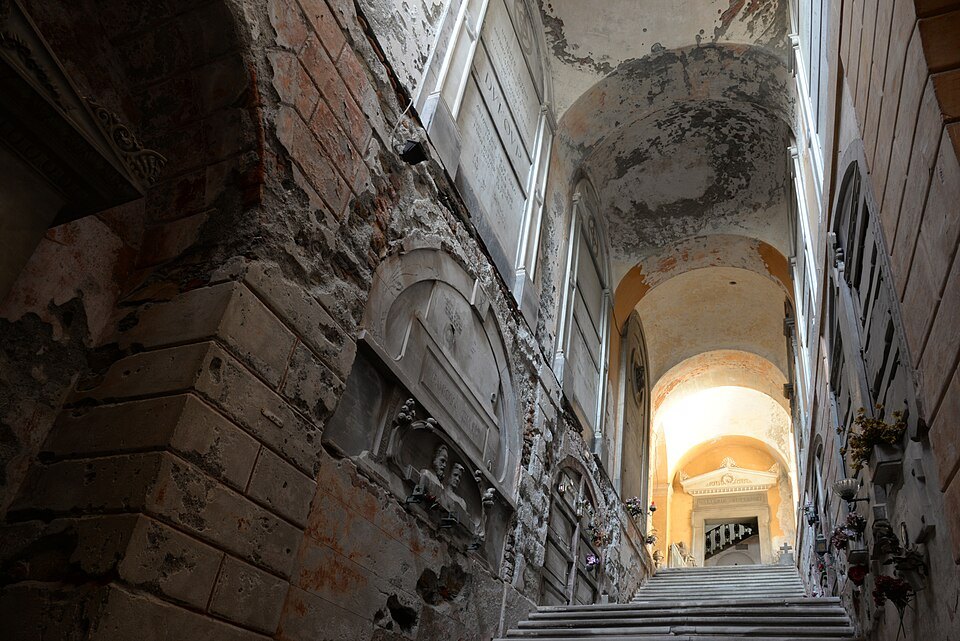
Construction began in 1844 and the cemetery opened on 2 January 1851. The layout is architectural rather than picturesque: a rectangle of colonnaded galleries framing an open lawn, a monumental stair, and the Pantheon at the top of the site, with the wooded Boschetto Irregolare climbing the hill behind it.
The sculpture arrived with the families who bought the plots. A tomb in the galleries was a public statement of standing, and the leading Ligurian sculptors of the century — Santo Varni, Lorenzo Orengo, Giulio Monteverde among them — spent entire careers filling them with figures.
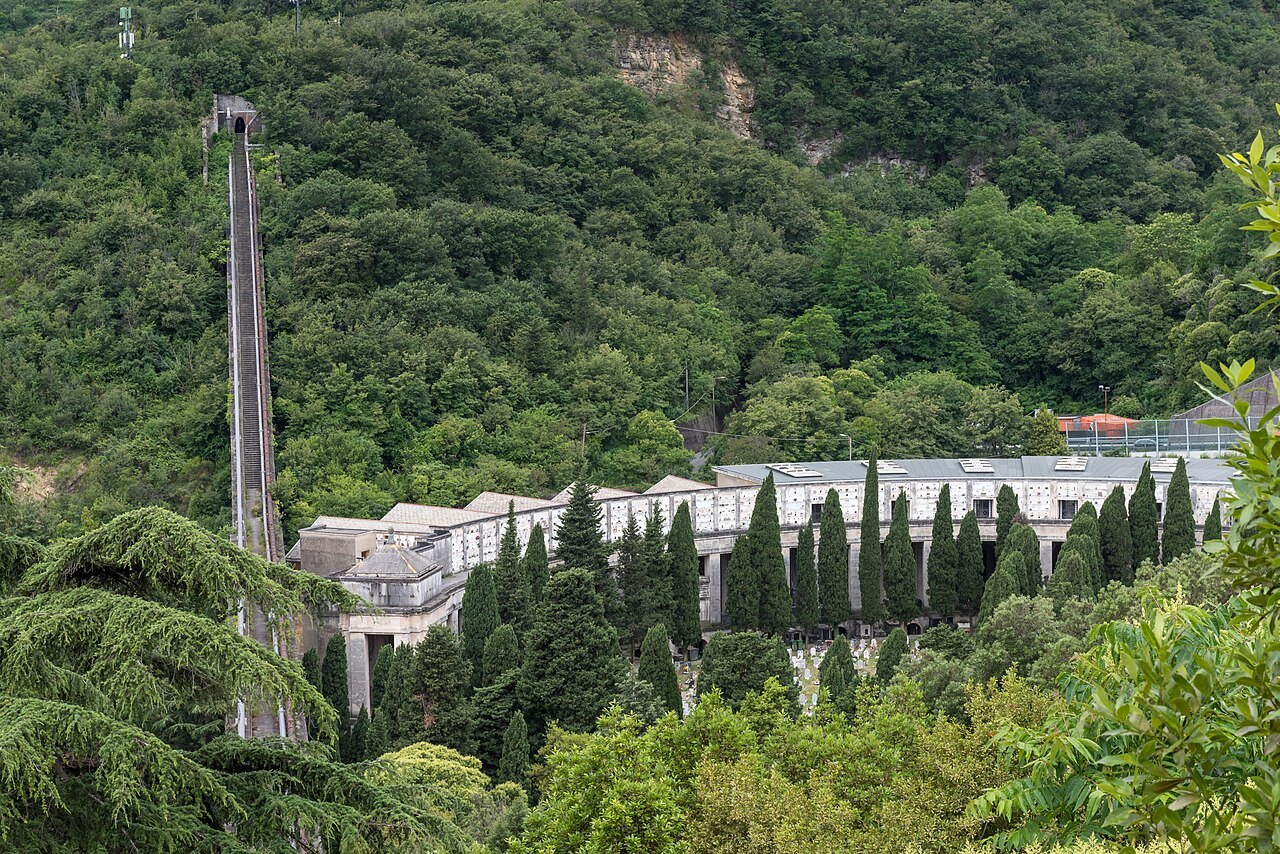
That scale was only possible because of the hillside itself. The galleries step up the slope in terraces, so the whole composition reads as a single building when seen from the valley floor, while each terrace keeps its own character: formal arcades lower down, wooded paths higher up.
What you actually see
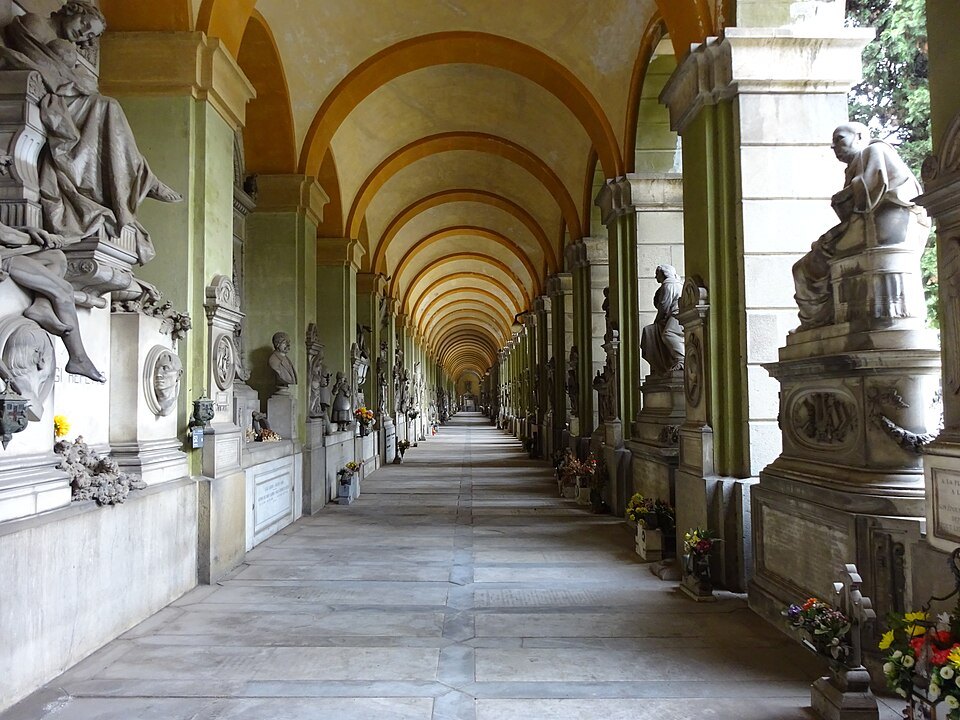
Walk in and the first impression is of scale: two tiers of arcades running away on both sides, each arch framing a family plot with its own marble group, figures carved at life size and sometimes reaching physically out of their niches toward the visitor.
At the center of the lawn stands Santo Varni's Statue of Faith, nine meters high and carved not for any individual grave but as an introduction to the whole cemetery. Behind it, at the head of a long stair, the Pantheon copies its Roman namesake with a Doric portico, flanked by statues of the prophets Job and Jeremiah.
The single monument most visitors come to find is that of Caterina Campodonico, carved by Lorenzo Orengo. She sold nuts and sugared bread at village festivals, saved for years, and paid for her own statue out of those earnings: she stands in her shawl holding her wares, with an inscription she commissioned herself explaining exactly what she had done.
Giuseppe Mazzini, one of the architects of Italian unification, lies in a tomb cut into the rock in its own enclosure. Others buried at Staglieno include Constance Lloyd, Oscar Wilde's wife, in the English cemetery, and the writers Edoardo Sanguineti and Fernanda Pivano. Higher up, the Boschetto Irregolare drops the grid entirely: monuments stand among cypresses and holm oaks on winding paths, as though a garden had been colonized by marble.
Getting there and visiting
City buses run up the Bisagno valley from the center of Genoa to the cemetery gates, and the ride is part of the interest: this is ordinary working Genoa, as far from the palace streets as the city gets. Check current routes and stops with the local transport operator before setting out; details on using buses generally are covered on the getting around page.
Allow at least two hours, and treat half a day as entirely reasonable if the sculpture holds attention. Printed maps at the entrance mark the main monuments, and the arcades alone can take an hour to walk properly.
Staglieno is a working cemetery and funerals take place within it; dress and behave as would be expected anywhere else, and keep cameras well away from mourners. The ground is steep and the upper paths are rough underfoot, so wear shoes that can cope with an incline, and carry water, since shade can be scarce in summer — see when to come for general guidance on the Genoa heat.
Admission has no charge, on any day of the week, though opening arrangements should be checked directly with the cemetery before visiting. Guided walks in English are run occasionally by the city and by local associations; otherwise the printed plan at the gate is normally enough to find the way around.
Honest notes
Weather has not been kind to some of the marble, and restoration work is continuous; scaffolding and roped-off sections of the arcades are a normal part of any visit, not a sign anything is wrong.
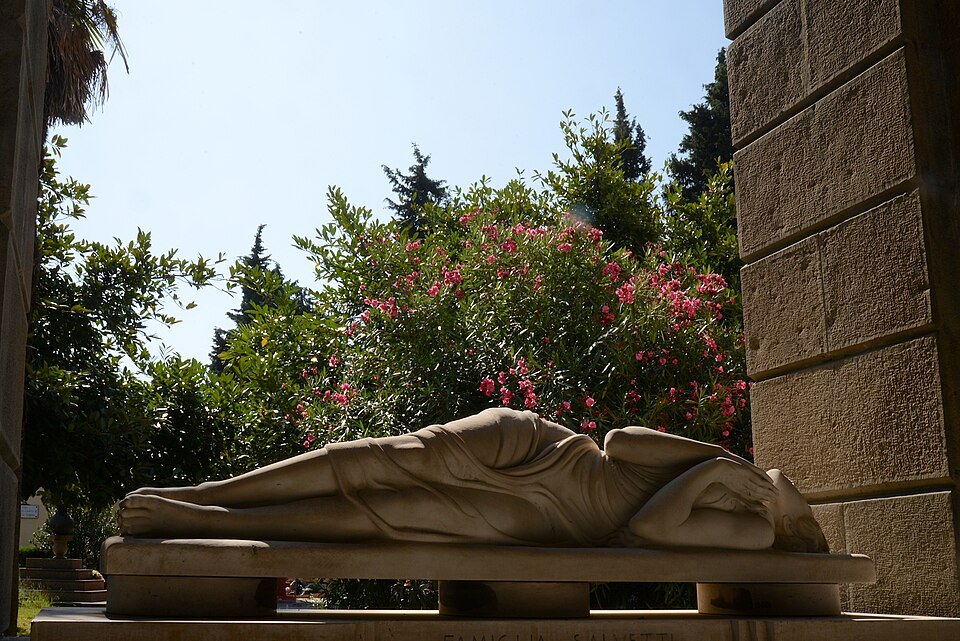
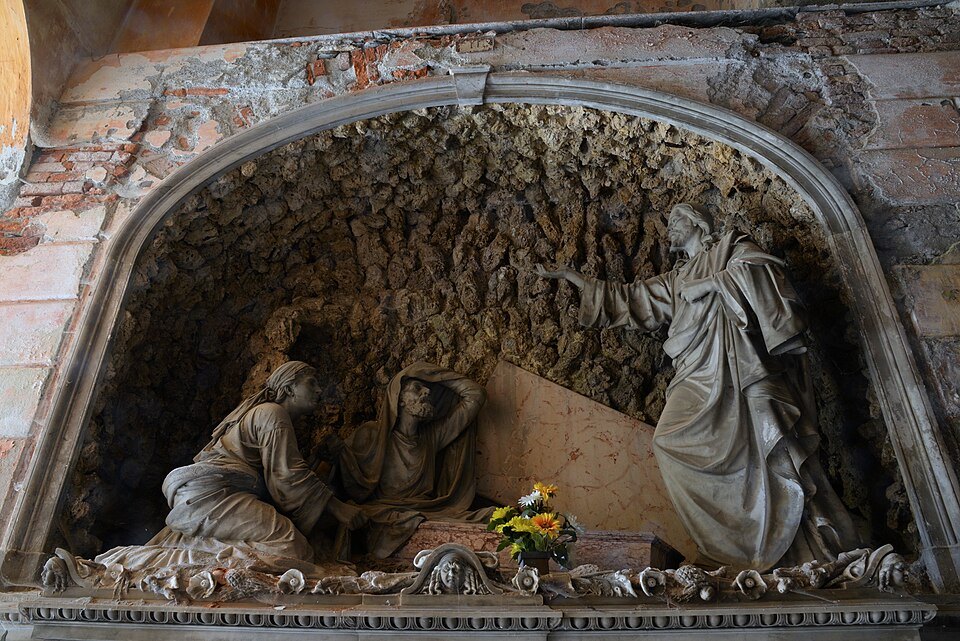
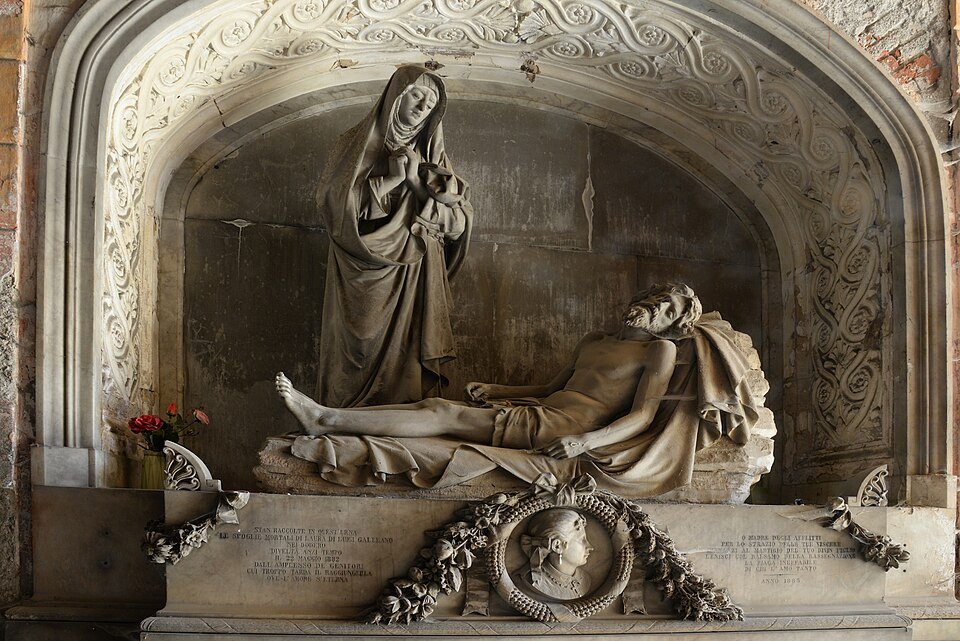
The realism that makes the sculpture remarkable can also be startling rather than sentimental — deathbeds, illness and grief are shown plainly, without softening. Some visitors find this more than they expected, and children in particular may find certain monuments unsettling.
The site lies roughly half an hour from the center of Genoa, so it needs to be planned into a day of its own rather than squeezed between stops on a walk through the main sights.
More from the journal
- Getting HereWhich Genoa station should you get off at, Principe or Brignole?A practical guide to Genoa's two main stations, which end of the city each serves, and how to choose.Read the piece
- The Righi Funicular and the FortsHow do you reach the forts above Genoa without a car?A funicular from the edge of the old town, a path along seventeenth-century walls, and four forts on the skyline — a half day from the centre with no car and no tour.Read the piece